
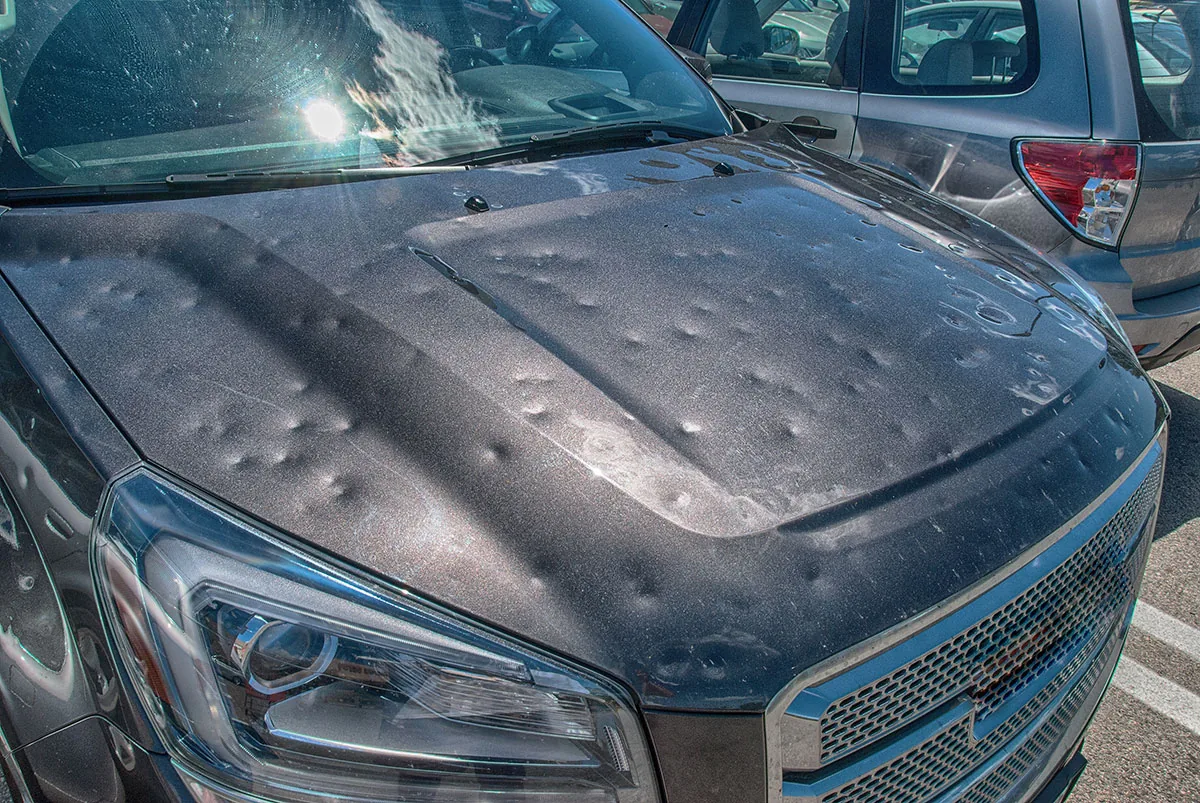
Picture a sudden hailstorm lasting only a few minutes on a corporate yard in Northern Italy: 120 cars hit, damages exceeding €216,000. It is no exaggeration — it happened to a logistics company in Lombardy, and similar cases recur every year. For a car dealership, it means weeks of unsellable vehicles. For a logistics fleet, days of operational downtime and lost revenue. The risk is no longer confined to the North: 2025 was the second worst year for intense weather phenomena in the last 11 years, with Genoa (12 events), Milan and Palermo among the hardest-hit cities (Legambiente, 2025).
In 2023, according to Legambiente, 39 significant hailstorms were recorded across Italy — ten more than the previous year. If you are a fleet manager, a logistics manager or a car dealership owner, this article shows you the real risk for your geographic area and how to calculate it in euros.
The risk map of Italy: it is not just the North
The picture has shifted structurally. In 2024, extreme weather events were already +485% compared with 2015; in 2025 the trend continued. In August 2025 alone, 834 hailstorms (+12% vs the 740 of August 2024) were recorded, with peaks in Veneto (187 events), Lombardy (154), Umbria and Sardinia (Datameteo, 2025).
| Area | Most exposed zones | Annual event prob. | Risk season |
|---|---|---|---|
| Northern Italy (highest risk) | Po Valley: Lombardy, Veneto, Emilia, Piedmont, FVG | 0.3 – 0.5 | April – August |
| Central Italy (medium-high risk) | South-central Tuscany, Marche, Umbria, southern Lazio | 0.15 – 0.25 | May – September |
| Southern Italy (rising risk) | Campania, Apulia (Tavoliere), eastern Sicily, Calabria | 0.10 – 0.20 | June – October |
Northern Italy: historic epicentre, record intensity
The Po Valley remains the area with the highest hail-damage frequency in Europe. Summer 2023: an EU record of 19 cm in diameter at Azzano Decimo (ARPA FVG). On 26 June 2025, a hailstorm with 10–12 cm hailstones struck the Treviso and Pordenone areas, damaging greenhouses, cars and yards (Rete Meteo Amatori, 2025).
Central Italy: the emerging risk
Tuscany and Marche, traditionally more sheltered, are recording increasingly frequent hail episodes. The belt between Arezzo, Siena and Perugia has seen high-energy storms over the last three years. Southern Lazio and Umbria: estimated probability of 0.15–0.25 per year.
Southern Italy: the new front
The South is now facing off-the-scale events. Campania (Irno Valley): hailstones over 6 cm, windscreens shattered. Apulia (Tavoliere) and eastern Sicily: recurring summer hail. The 2025 trend confirms the growth in frequency and intensity in the South as well (Legambiente, 2025). For 2026 seasonal projections and the macro-climatic analysis, see also climate risk Northern Italy 2026: March–October outlook.
The real cost for your fleet: 2023–2026 breakdown
The data are based on Federcarrozzieri and ANIA records, updated to 2024. In total, hailstorms cost Italian cars about €390 million a year in insurance claims — excluding non-covered damage, residual value loss of the fleet and operational losses from downtime.
| Type of damage | Documented average cost | Source |
|---|---|---|
| Bodywork — moderate damage | €900 – €2,000 | Federcarrozzieri 2023–24 |
| Bodywork — severe damage | €3,500 – €10,000 | Federcarrozzieri 2023–24 |
| Windscreens and glazing | €500+ per panel | Industry estimates |
| Vehicle downtime (5–14 days) | €750 – €2,100 | Productivity loss — see the domino effect of fleet downtime |
| Per-vehicle total (medium-severe scenario) | €2,500 – €6,000 | — |
Car dealerships: the hidden risk of an exposed inventory
For a logistics company, a hailstorm means vehicles out of service and lost productivity. For a car dealership, the problem is even more severe: every vehicle damaged on the lot becomes unsellable until fully repaired — often for weeks.
Insurers generally cover only part of the exposed fleet, and after a significant hail event many companies raise premiums or reduce coverage at renewal. Reputational damage is a further variable: news that a dealership's inventory has been damaged can dampen purchase intentions in the area.
The cost of a single event on a lot of 80–100 vehicles can exceed €300,000, combining repairs, lost sales and depreciation of the inventory. For the full picture of hail damage recorded in Northern Italy during the most critical year, see 2024 hail damage in Northern Italy and the Cat Nat 2025 rules. Dedicated solutions: hail protection covers for car dealerships.
Calculate your fleet risk: 2025–2026 formula
Probability must be adapted to your region. Use the P value from the table above:
Annual risk (€) = (No. of vehicles × average damage × P) + (total downtime days × daily cost)
P = event probability: North 0.3–0.5 | Centre 0.15–0.25 | South 0.10–0.20
Example 1 — Logistics fleet, 50 vehicles, Lombardy (P = 0.4)
Average damage: €3,500 | Downtime: 5 d × 50 vehicles = 250 d | Daily cost: €200
Result: (50 × 3,500 × 0.4) + (250 × 200) = 70,000 + 50,000 = €120,000 of annual risk
Example 2 — Car dealership, 80 vehicles, Tuscany (P = 0.2)
Average damage: €3,500 | Sales downtime: 8 d × 80 vehicles = 640 d | Daily cost: €150
Result: (80 × 3,500 × 0.2) + (640 × 150) = 56,000 + 96,000 = €152,000 of annual risk
Example 3 — Corporate fleet, 60 vehicles, Campania (P = 0.15)
Average damage: €3,000 | Downtime: 6 d × 60 vehicles = 360 d | Daily cost: €180
Result: (60 × 3,000 × 0.15) + (360 × 180) = 27,000 + 64,800 = €91,800 of annual risk
Even in the South, with lower probability, annual risk exceeds the cost of a structural cover starting from fleets of 30–40 vehicles.
Want to calculate the risk for your fleet?
Free on-site survey and tailored assessment for yards, dealerships and corporate vehicle parks.
Insurance or physical protection: the difference that matters
Insurance is necessary, but on its own it is not enough — for three structural reasons.
- It covers only part of the damage. Weather-event coverage is held by only 12% of policyholders (ANIA). Deductibles, caps and restrictive clauses often reduce the real reimbursement. For dealerships, insurance typically covers only 30–50% of the exposed inventory.
- Operational downtime cannot be recovered. Weeks of stopped or unsellable vehicles mean a direct loss of productivity or revenue that no policy fully reimburses.
- The premium goes up after every claim. An event on a fleet or yard triggers a renewal increase that compounds over the following years.
Physical protection eliminates the cause of the damage; it does not indemnify it after the fact. Hail protection covers for corporate parking and yards qualify as depreciable capital assets — cost spread over time, benefit immediate from the very first event. For the detailed ROI analysis with A/B scenarios and payback formula, read anti-hail covers for companies: investment or avoidable cost?.
Euromet solutions: hail protection for fleets, dealerships and yards
Euromet solutions for corporate fleets, car dealerships and industrial parking include PVC covers, hybrid PVC/metal structures and retractable systems — designed for commercial yards, logistics depots and large open areas. For a full overview of the available systems, see our page dedicated to hail protection covers for cars and fleets. For very large yards, see also hail protection nets for large car parks with 100 or more vehicles.
| Feature | Detail |
|---|---|
| Certified resistance | Hailstones up to 50 mm in diameter |
| Drainage | Automatic, integrated into the structure |
| Scalability | From 10 to thousands of m² — modular installation |
| Regulatory compliance | UNI standards for cover structures in industrial areas |
| Operational impact | Zero downtime in most cases |
| Tax classification | Depreciable capital asset |
Installation cost is typically paid back within the first year of avoided risk. For car dealerships, protecting the inventory also means preserving stock value and commercial reputation.
Frequently asked questions (FAQ)
Request a tailored quote
Whether your fleet operates in Milan, Florence, Naples or Bari — and whether you manage a corporate parking lot, a logistics yard or a dealership inventory — hail risk is now a measurable economic variable. A single event on 50–100 vehicles can cost more than the entire useful life of a protection structure.
Protect your fleet from hail
On-site survey, project and free quote — response within 24 working hours.