
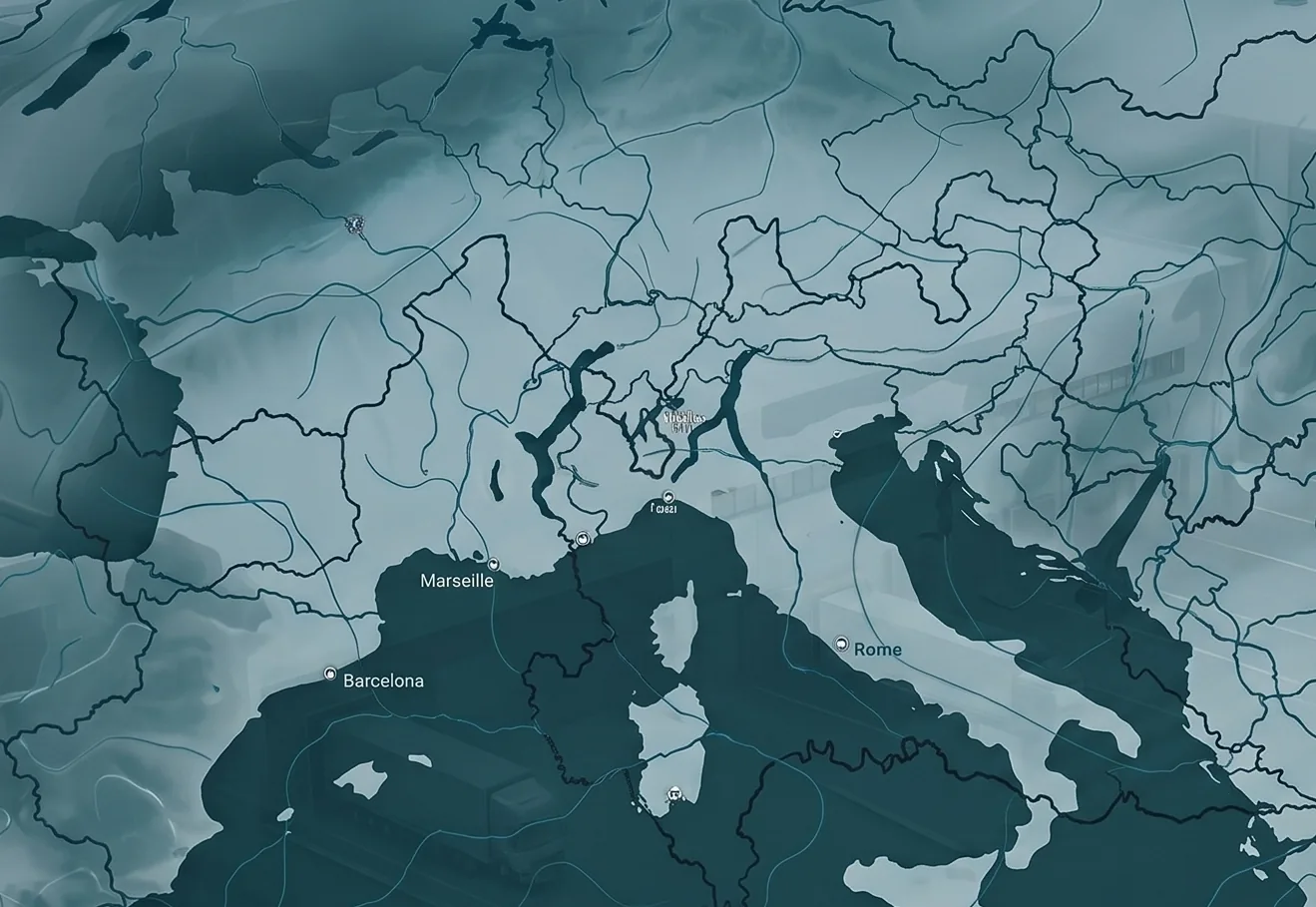
For businesses operating in Northern Italy, climate risk has firmly moved beyond environmental debate and become a primary operational and financial variable. Statistical evidence from the past two years points to increasing frequency and intensity of extreme weather events, with direct consequences for company fleets, logistics yards, car dealerships and large industrial facilities.
A structurally unstable macro-climate context
According to the European State of the Climate, published annually by Copernicus and the World Meteorological Organisation (WMO), continental Europe is warming faster than the global average. For Northern Italy and the Po Valley, this translates into sharper thermal contrasts: unstable air masses moving over superheated surfaces generate increasingly violent convective phenomena.
Historical data from the ESWD (European Severe Weather Database) confirm that this is not a sequence of isolated incidents, but a structural shift in the regional risk profile, with the critical weather season extending progressively. The 2024 season made this clear: 433 significant hailstorms in Italy between January and August, concentrated in the North, with hailstones up to 19 cm in Friuli and €3.7 billion in insured losses in July alone (ANIA).
Risk scenario analysis: March–October 2026
March–May: early-season energy surge
Spring represents the first critical window for corporate asset protection. Seasonal forecast models from the C3S (Copernicus Climate Change Service) highlight early instability, driven by persistent thermal anomalies over the Mediterranean basin.
- Localised hailstorms with medium-diameter but high-density hailstones.
- Sudden pressure drops capable of producing sharp, damaging wind gusts.
- Intense rainfall overloading drainage systems on open yards and car parks.
June–August: thermal peak and giant hail
Summer months remain the highest-risk period for insurance claims. The accumulation of heat and humidity in the lower atmospheric layers of the Po Valley acts as fuel for supercell thunderstorms. The primary threat is hail associated with downbursts — violent descending wind gusts that can exceed 100 km/h. CNR and ESWD data show a rising frequency of hailstones exceeding 4–5 cm in diameter — sufficient to destroy windscreens, bodywork and unprotected solar panels.
September–October: an extended risk season
Autumn no longer represents a period of reduced risk. Heat stored during summer is released upon contact with the first Atlantic depressions, generating severe hailstorms and flood-level rainfall that extend fleet vulnerability well into the end of the operational year. The risk window now spans eight consecutive months — far more than the three or four months typical of previous decades.
Want to assess the weather risk for your site?
Request a free Euromet technical consultation: we analyse the risk profile of your yard and propose a solution sized to the real needs of the site.
Impact on Risk Management: real business costs
Operational downtime and blocked logistics
Delivery delays, contractual penalties and supply chain disruption. In the most hail-prone areas, operational downtime can double the total cost of a hail event compared with physical repair costs alone. For a detailed analysis of hidden costs, see fleet downtime after a hailstorm.
Asset depreciation
A fleet damaged by hail suffers immediate depreciation even after formal repair, directly affecting residual fleet value and resale pricing.
A tightening insurance market
ANIA data confirm that rising weather-related claims have already led insurers to increase premiums and excesses in high-exposure areas. A physical protection structure improves the company's risk profile and strengthens negotiating leverage with insurance brokers. For the Cat Nat 2025 regulatory context, see corporate parking protection after the Cat Nat obligation.
Preventive protection: Euromet solutions
Addressing the climate variability of 2026 requires infrastructure engineered to withstand severe mechanical stress. Euromet solutions are designed to precise engineering standards:
- NTC 2018 compliance (Italian Technical Standards for Construction, equivalent to Eurocode standards) — structures calculated for hail resistance, snow loads and downburst wind pressures.
- Modularity and scalability — systems for logistics hubs, industrial car parks and dealership forecourts, without disrupting operational flows.
- Measurable ROI — by eliminating vehicle damage risk and zero-rating indirect downtime costs, the infrastructure pays for itself from the first event avoided.
All available systems are described on the pillar page dedicated to hail protection covers for cars and fleets.
Frequently Asked Questions (FAQ)
Protect your assets before the next season
Forecasts for March–October 2026 confirm that weather instability is a structural constant for Northern Italy. Waiting for an extreme event to quantify the damage is a risk that modern management can no longer afford. Preventive protection of outdoor assets is now the dividing line between reactive business management and a genuine business continuity strategy.
Request a free Euromet technical consultation
We assess your site's risk profile and design the most suitable solution — reply within 24 working hours.
Sources: Copernicus C3S / ERA5 — Climate Bulletin April 2026 · WMO — European State of the Climate, annual reports · ESWD — European Severe Weather Database (eswd.eu) · ANIA — Natural catastrophes July 2024: €3.7bn insured losses · CNR — Research on hailstorm frequency in the Po Valley · NTC 2018 — Italian Technical Standards for Construction, Ministerial Decree 17 January 2018.