
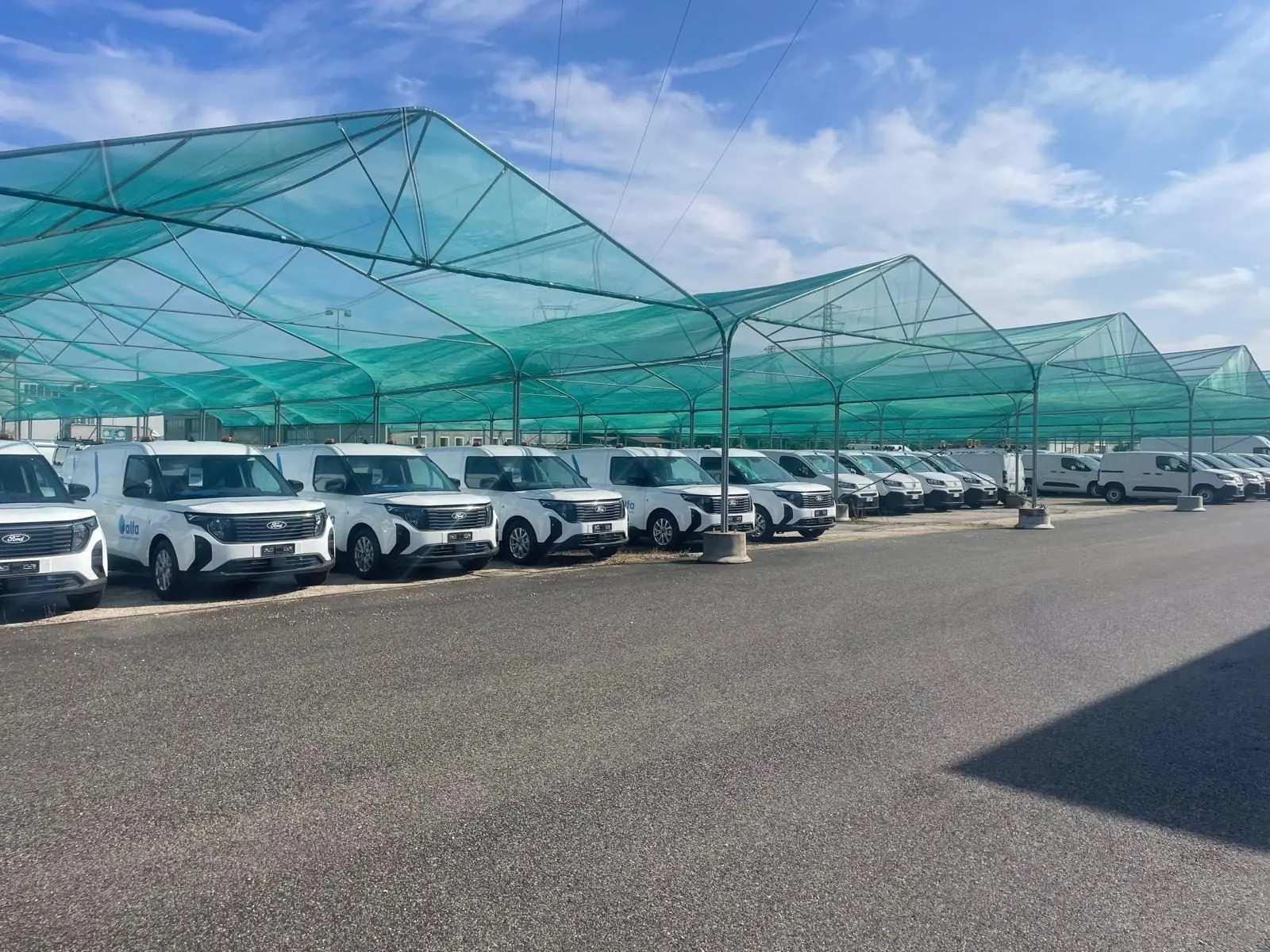
For many businesses, hail remains an underestimated risk — until it strikes. Within a matter of minutes, a single weather event can damage dozens of vehicles, halt operations, generate multiple insurance claims and trigger a chain of costs that goes well beyond bodywork repairs.
This article analyses the real economic impact of hail on fleets and industrial yards, and evaluates — with verifiable data — when and for whom a physical protection structure represents a justifiable investment.
Why hail risk has grown in recent years
Available data indicate an increase in the frequency and intensity of extreme weather events in Italy, particularly across the Po Valley and the pre-Alpine foothills. The ESWD (European Severe Weather Database) is one of the most widely used reference sources in the insurance and meteorological sectors.
The Italian insurance market reflects this trend. According to ANIA data, claims in weather-related property damage lines are rising, with a direct impact on the overall cost of corporate insurance portfolios. Legambiente's 2025 Città Clima Report confirms that events such as intense hailstorms, flash flooding and strong winds are increasing in Italian urban and peri-urban areas, with growing consequences for business infrastructure and assets. For the Copernicus/ESWD analysis of the March–October 2026 outlook, see climate risk Northern Italy 2026: outlook for the North.
What actually happens when a business is hit by hail
An intense hailstorm striking an uncovered business yard does not produce a single, isolated cost — it generates a chain of cascading losses:
- Direct bodywork and glass damage to exposed vehicles.
- Operational downtime during repair periods (5–14 days per vehicle).
- Replacement hire costs or delivery delays.
- Insurance excesses and deductibles payable by the business for each claim.
- Commercial depreciation of damaged vehicles, particularly for automotive fleets.
- Internal administrative time absorbed by claims management.
Federcarrozzieri has documented consistent increases in average hail repair costs in recent years, driven by rising parts and specialist labour costs. The average cost of a settled motor claim in Italy exceeded €2,105 in 2023 (ANIA, +4.2% vs 2022). The complete analysis of the domino effect of indirect costs on logistics, automotive and industry is available in the deep dive on fleet downtime after a hailstorm.
Want to calculate the real risk for your fleet or yard?
Contact Euromet for a free assessment: we analyse your exposure profile and the potential ROI of the investment.
Cost analysis: how to evaluate the ROI of anti-hail protection
To properly assess whether a hail protection structure is economically justified, two scenarios must be compared:
Scenario A — No physical protection, insurance only: every significant hail event generates direct and indirect costs that fall on the company's balance sheet, partially covered by the policy (net of excesses, deductibles and policy limits), partially not.
Scenario B — Physical protection installed: the structure eliminates or drastically reduces damage risk, cancelling the cascade of secondary costs. The structure cost is spread over its useful life, making the annualised cost comparable to expected claim costs.
| Cost item | Description | Reference |
|---|---|---|
| Bodywork repairs | Hail damage to exposed vehicles | Federcarrozzieri 2023–24 |
| Operational downtime | Vehicles unavailable during repair period | Sector-specific variable |
| Excesses and deductibles | Amount payable by the business per claim | Depends on policy |
| Commercial depreciation | Reduced value of damaged vehicles | Used car market |
| Administrative burden | Internal time for claims management | Internal estimate |
| Total estimated cost | Variable — requires site-specific analysis | — |
Worked example: logistics fleet, 30 vehicles
In high-exposure scenarios — yards with many vehicles or valuable stock in medium-to-high meteorological risk zones — the investment payback period may be just a few years. In other contexts, the primary benefit may be a reduction in cost volatility and improved operational continuity — which has real value even in years when a major event does not occur. For the full risk calculation formula, see how much a hailstorm costs a company with a fleet; for yards above 100 vehicles, see hail protection nets for large car parks.
The regulatory framework: Cat Nat and physical protection
One factor that has accelerated reflection among Italian businesses is the introduction of mandatory insurance for catastrophe risks, established by Law 213/2023 and Ministerial Decree 18/2025, with subsequent clarifications from MIMIT through official FAQs. For the specific impact on corporate parking protection and the new priorities of fleet managers and CFOs, see corporate parking protection: why 2025 changed the priorities. For the building-permit framework (CILA, SCIA, Permesso di Costruire), see car canopy permits for companies.
Euromet solutions: modular protection for operational areas
Euromet designs and installs tensile structures, canopies and anti-hail carports for industrial yards, company fleets and logistics areas. Solutions are sized to the specific area, intended use and structural characteristics of each site.
- Continuous protection of vehicle fleet or exposed stock.
- Elimination or drastic reduction of hail and other weather-related damage.
- Greater cost predictability and reduced operational volatility.
- Optional photovoltaic integration — transforms a defensive investment into an energy-generating asset.
- Potential insurance profile optimisation over time.
All available systems are described on the pillar page dedicated to hail protection covers for cars and fleets.
Frequently Asked Questions (FAQ)
The first step: a technical site assessment
Hail is not an unpredictable risk — it is a manageable one. For businesses with uncovered yards, large fleets or valuable stock, evaluating physical protection should follow the same logic as any other infrastructure investment: starting from data, not perception. The first step is a technical assessment of the site and its real exposure. Only on that basis is it possible to calculate a reliable ROI and make an informed decision.
Request a free Euromet site assessment
We calculate the risk profile together and provide a personalised ROI estimate — no commitment required.
Sources: ANIA — Claims statistics, property damage lines · Federcarrozzieri — Hail damage repairs observatory 2023–2024 · ESWD — European Severe Weather Database (eswd.eu) · Legambiente — Città Clima Report 2025 · MIMIT — Cat Nat insurance: official FAQs (mimit.gov.it) · Law 213/2023 and DM 18/2025 — Mandatory Cat Nat insurance for businesses.