
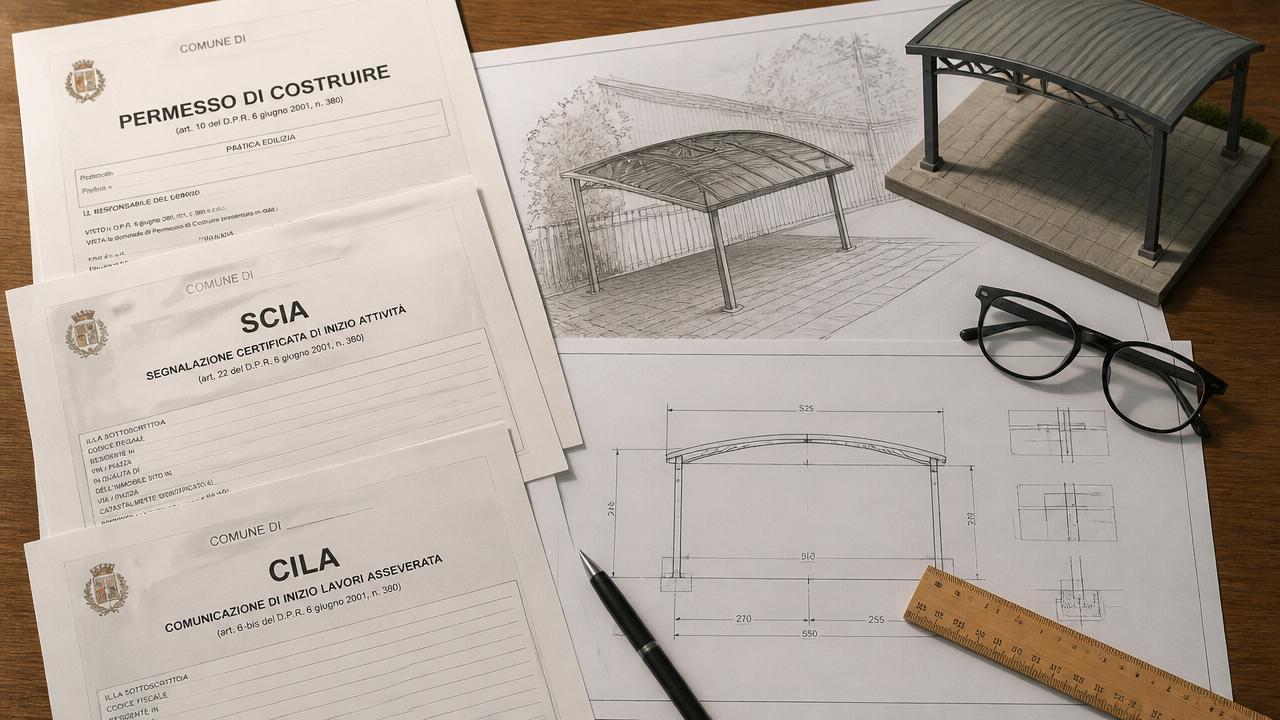
One of the most frequent questions we get from fleet managers, facility managers and dealership owners is: "Do I need a building title to install a car cover on the corporate parking lot?" There is no single answer valid in every context. In general terms, the building qualification of car canopies, shading structures and hail-protection covers depends on the specific characteristics of the intervention and must be determined on a case-by-case basis, subject to the verification of a qualified professional and the technical office of the competent Municipality.
This informative guide recalls the main references of the Italian regulatory framework (Consolidated Building Act — DPR 380/2001, Ministerial Glossary of Free Building — DM 2 March 2018) applicable to car canopies, shading structures and hail-protection covers on commercial and industrial yards. The goal is to provide useful informative orientation to help setting up the preliminary verification stage — not personalised legal or technical advice.
"Car canopies without a permit": a wording to clarify
The online search "car canopies without a permit" is very popular but the wording is ambiguous and may be misleading: as a rule, there is no "general right" to install a canopy in the absence of any building verification. There is, at most, a restricted set of works that the legislator has classified as Free Building (art. 6 DPR 380/2001 and the 2018 ministerial Glossary), for which simplified regimes may apply — subject to local rules and case-by-case verification.
For a work to potentially fall within Free Building, national law generally requires the simultaneous presence of several requirements, including:
- Easily removable structure, not permanently fixed to the ground with masonry works.
- Purpose of meeting temporary or contingent needs.
- Absence of independent urban and building relevance (no significant change to volume, shape or surface).
- Compliance with health, safety, landscape and seismic regulations.
Car covers and hail-protection structures that are stable, anchored to the ground and intended to last over time hardly fall within a simplified regime: in many cases they may require an ordinary building title or, at least, a preliminary technical and administrative assessment. The qualification of the work depends in particular on structure and materials, anchoring, size, impact on volume, shape and surface, plus any landscape, zoning, seismic or environmental constraints.
Which building title may be required
Determining the applicable building title is not automatic and cannot be resolved through a general rule: it depends on the physical characteristics of the intervention, the area where it sits and the discipline of the competent Municipality. Purely for orientation, the ordinary regimes established by DPR 380/2001 are the following.
| Reference | Regime | Indicative scope |
|---|---|---|
| art. 6-bis DPR 380/2001 | CILA (Notified Start of Works) | Minor interventions not attributable to other titles, subject to case verification. |
| art. 22 DPR 380/2001 | SCIA (Certified Notification of Start of Works) | Interventions subject to a certified notification asseverated by a qualified professional. |
| arts. 10 and 20 DPR 380/2001 | Building Permit | New constructions and interventions with significant urban relevance. |
Accessory procedures may apply when the area is subject to constraints — such as landscape authorisation (Legislative Decree 42/2004), seismic procedures (depending on the zone classification), the Fire Brigade opinion for activities subject to fire safety control, and, in some cases, specific environmental authorisations. Identifying the applicable regime must be performed by a qualified professional based on the local discipline and the characteristics of the work.
Do you want to set up the preliminary verification correctly?
Euromet technicians support the client's appointed professional with structural documentation and information useful for the technical qualification of the work.
Solar canopies: partially specific profiles
For photovoltaic systems installed on parking lots, national law on renewable energy sources (Legislative Decree 199/2021 and subsequent amendments) provides, in some cases, specific procedural regimes — such as the PAS (Simplified Authorisation Procedure) or the communication to the Municipality — whose applicability must be verified based on the characteristics of the project and the local discipline.
It is worth noting that any simplified regime typically concerns the photovoltaic system itself: the support structure, if it has autonomous building relevance, may require a separate assessment. For solar canopy solutions for parking lots, see the dedicated solar canopies page and the guide to industrial solar canopies for automotive and fleet operators.
Risks in the absence of a proper technical qualification of the work
Installing a permanent cover without the correct building title may constitute, depending on the case, a building irregularity. Possible consequences, generally provided for by DPR 380/2001, depend on the type and severity of the violation and may include:
- Orders to restore or demolish, with costs borne by the responsible party.
- Administrative pecuniary sanctions, varying with the nature of the intervention and the presence of constraints.
- Criminal profiles in case of interventions in landscape-protected, seismically restricted or otherwise constrained areas (art. 44 DPR 380/2001).
- Limits on access to the amnesty procedure (art. 36 DPR 380/2001), especially where the work conflicts with the current zoning instrument.
- Possible implications on insurance relationships, to be verified directly with the insurance company on the basis of the policy conditions.
For these reasons too, it is advisable to set up the building verification of the intervention with a qualified professional from the outset, avoiding installation without a clear administrative qualification.
Orientation checklist for the corporate manager
Before starting a hail-protection cover intervention on a corporate parking lot, a reasonable preliminary verification path may include:
- Preliminary urban verification: use classification of the cadastral parcel, municipal urban planning document (PCT/PRG in Italy), any landscape, historic, hydrogeological or environmental constraints.
- Appointment of a qualified professional (architect, engineer or licensed surveyor) for the qualification of the work and the preparation of the documents.
- Engagement with the technical office of the competent Municipality, including any preliminary opinions or pre-review services offered by the authority.
- Structural technical report with load calculations (snow, wind, seismic), signed by a licensed structural engineer.
- Identification of the applicable building title based on the technical assessment and the local discipline, and compliance with the relevant procedural timelines before the start of works.
- Update of insurance coverage once works are complete, assessing with your broker or insurance company any implications on property and vehicle policies.
Why setting up building compliance correctly matters
A yard with a hail-protection structure that is properly qualified from a building standpoint is, in general, a more solid asset: it contributes to the property's value, it lends itself to orderly tax management as a multi-year investment, it integrates more easily into insurance management and reduces exposure to administrative disputes. Conversely, a work that is not properly authorised may generate latent liabilities — during due diligence, property sale or a loss event — that are difficult to manage retroactively.
For a complementary analysis on the economic profile of investing in hail-protection covers, see also anti-hail covers for companies: investment or avoidable cost?
Frequently Asked Questions
Set up the project with the building verification already in place
Euromet supports the company in the technical phases of the project — from the technical inspection to the delivery of signed structural documentation — so that the client's trusted professional can manage the municipal process with a clear technical framework. Verifying the applicable building title remains, in any case, the exclusive competence of the qualified professional and of the technical office of the Municipality.
Technical inspection and documentation for the technical office
Personalised quote and documentation support for the building verification — reply within 24 working hours.
Regulatory references (indicative): DPR 380/2001 — Italian Consolidated Building Act · DM 2 March 2018 — Unified Glossary of Free Building · Legislative Decree 199/2021 — Implementation of the RED II Renewables Directive · Legislative Decree 42/2004 — Code of Cultural Heritage and Landscape · arts. 36 and 44 DPR 380/2001.