
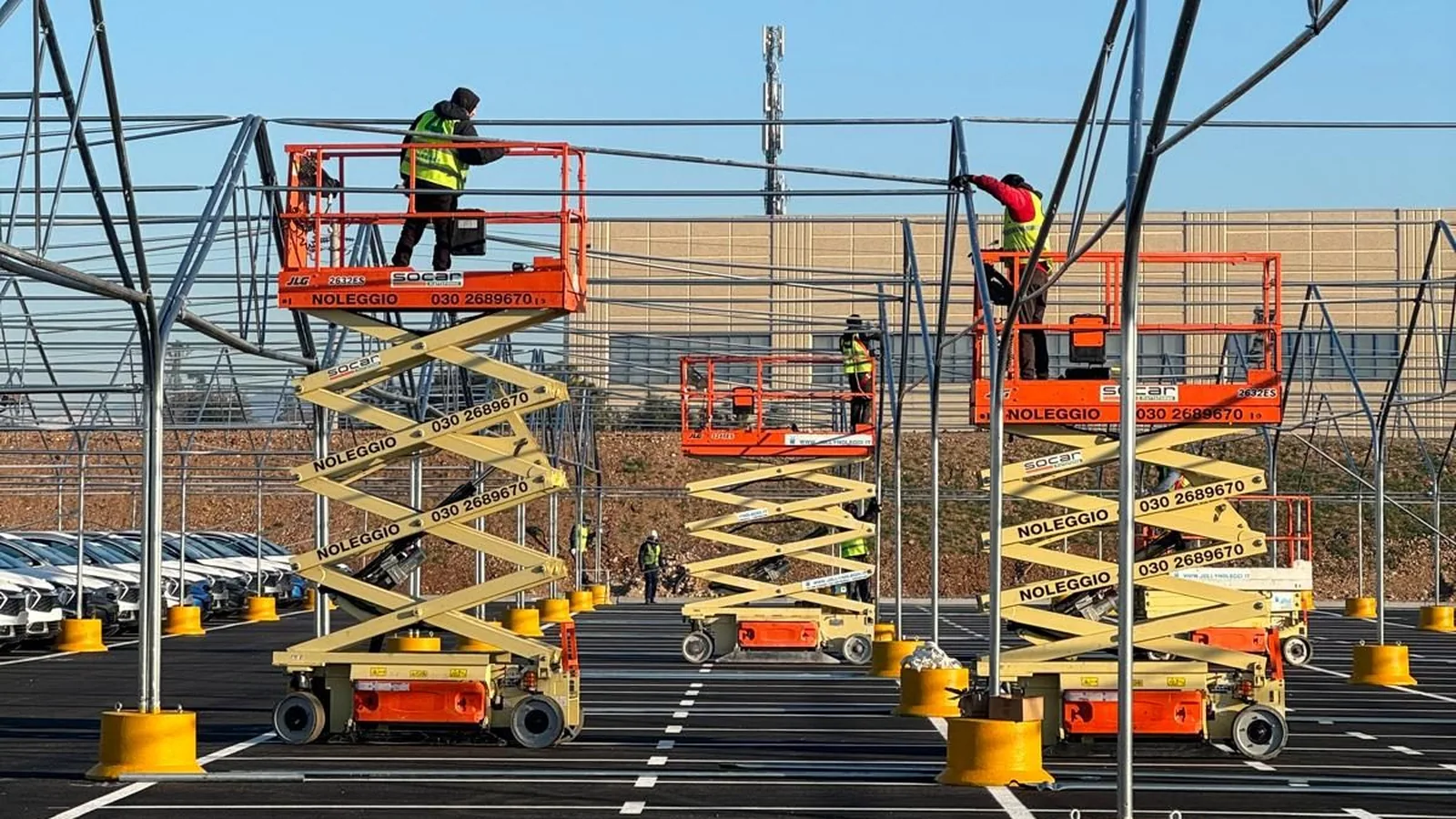
In 2025, the Italian third-party logistics sector exceeded €112 billion in turnover, confirming its position as one of the most dynamic segments of the national economy. Business growth has been accompanied by equally significant physical expansion: logistics surfaces, yards and storage areas continue to multiply — and with them, the exposure of corporate fleets to extreme weather events.
For operators with fleets of more than 100 units, standard cover solutions are no longer adequate. What is required are structures designed to integrate with business processes, scale without interruption and reduce the impact of adverse weather on service continuity. Modular cover structures are the most operationally efficient technical response to these requirements.
The context: a growing sector, a rising operational risk
Sector data describe an industry expanding on both the business and real estate fronts, with direct effects on demand for fleet and yard protection infrastructure:
| Indicator | Figure | Source |
|---|---|---|
| Third-party logistics turnover in Italy, 2025 | €112.4bn, +1.9% | Contract Logistics Observatory, Politecnico di Milano |
| Projected real growth for 2026 | +0.3% | Contract Logistics Observatory, Politecnico di Milano |
| Logistics space take-up in Italy, 2025 | 2.5m m², +7% p.a. | Scenari Immobiliari, Report 2026 |
| Logistics space take-up, Q1 2026 | 860,000 m², +78% y/y | JLL, Q1 2026 |
| Investment in Italian logistics sector, 2025 | €2.05bn, +17% | Scenari Immobiliari, Report 2026 |
| Cost of vehicle downtime per event | Up to €1,688 | Fleet sector study |
| Fleet managers reporting increased downtime stress | 41% | Fleet sector study |
| Fleet managers reporting client complaints from service disruption | 24% | Fleet sector study |
The picture is clear: more logistics space in use, more vehicles in transit and at rest, and a vehicle downtime cost that — even without a severe weather event — can already exceed €1,600 per vehicle affected. Across a fleet of hundreds of units, even a single weather event that simultaneously grounds several vehicles translates into a significant economic and organisational impact, compounded by client complaints and overtime costs to recover service delays. The full domino effect is analysed in the hidden costs of hail-related fleet downtime.
Why the logistics sector requires modularity
Logistics hubs, distribution centres and large yards are in constant evolution: fleet changes, new operational lines and reorganisation of loading and unloading areas are routine. A modular solution enables:
- Progressive scalability: additional modules installed without redesigning the entire installation.
- Phased installation, spreading investment over time.
- Adaptation to specific traffic and access requirements, even as these change over time.
Want to assess how modular cover structures could work for your fleet?
Contact Euromet for a free technical evaluation of your site: we assess spaces, operational flows and installation phases.
Concrete benefits for operations and fleet managers
- Operational continuity: modules designed for partial installation minimise interference with daily activities, with works plannable during off-peak hours or in dedicated lanes.
- Faster delivery: prefabricated modular structures reduce on-site installation time compared with traditional construction solutions, with logistics impact plannable in advance with the operations team.
- Financial scalability: the ability to phase investment and connect new units in line with actual operational requirements.
- Space optimisation: bespoke design for manoeuvring lanes, loading and unloading areas and temporary parking, maximising available capacity.
- Integrated protection: beyond hail, the covers also limit damage from heavy rain, UV exposure and general wear, reducing vehicle maintenance costs and preserving residual value.
For yards with more than 100 vehicles, the most widely adopted technical solution is a hail protection net on a modular structure: see hail protection nets for large car parks. Dedicated applications are described on the hail protection for logistics and corporate parking pages.
ROI: the metrics to monitor
In light of vehicle downtime cost data, investment in modular cover structures translates into concrete, measurable indicators over time:
- Reduction in accidental damage per weather event, with a consequent fall in repairs and vehicle downtime.
- Fewer service interruptions and client complaints linked to delivery delays.
- Reduced overtime costs for staff required to recover disrupted operational flows.
- Lower total cost of ownership (TCO) for the fleet, thanks to reduced maintenance and longer vehicle service life.
For a fleet of several hundred vehicles, even a modest reduction in the frequency of weather-related vehicle groundings translates — on an annual basis — into a measurable saving compared with the management cost of an unprotected fleet. For the full calculation methodology, see anti-hail covers: investment or avoidable cost?
Integration with operational flows
Genuinely effective design starts from an analysis of operational flows: entry and exit routes, movement simulations, loading points and temporary parking areas. Euromet modular structures integrate with:
- Anti-snag systems for heavy goods vehicles.
- Dedicated pedestrian routes and signage.
- Light maintenance areas, without interrupting service.
This approach reduces bottlenecks and improves overall operational safety across the yard.
Design flexibility and maintenance
The modular approach also simplifies planned maintenance: individual sections can be isolated for targeted works without compromising the entire cover. The standardisation of components also facilitates spare parts supply and documentation management — technical data sheets, maintenance checklists, inspection schedules.
Why modularity is strategic for businesses
Modularity is not merely a technical advantage: it is a strategic choice that allows businesses to plan expansion with lower financial and operational exposure. In a logistics market that, according to sector observers, is still growing but with tighter margins, it gives logistics directors and site managers a risk management tool that protects service continuity and simplifies asset governance.
EUROMET.IT S.r.l.: bespoke modular design
EUROMET.IT S.r.l. designs modular cover structures and industrial facilities for dealerships, corporate fleets, logistics hubs and large yards. Every project begins with:
- Technical analysis of the site's spaces and operational flows.
- Verification of applicable regulatory and safety requirements.
- A scalable expansion plan, with delivery timescales defined phase by phase.
The result is modular solutions that maximise operational resilience, optimise total cost of fleet ownership and scale with the client's growth requirements. All available systems are described on the page dedicated to hail protection covers for cars and fleets.
Pre-site-visit checklist
Before defining the number of modules and installation phases, every project starts with a technical site visit. These are the key points to prepare:
- Yard dimensions and site plan.
- Operational flows: entry and exit points, loading and unloading areas.
- Regulatory and planning constraints applicable to the site.
- Access requirements for heavy goods vehicles and manoeuvring space.
- Possible installation phases and preliminary estimate of modules required.
Arriving at the site visit with this information already organised significantly accelerates the technical design phase.
Frequently asked questions (FAQ)
Design a bespoke modular cover for your fleet
In a sector that continues to grow but where, according to market observers, margins have tightened, every operational inefficiency carries a higher cost. A well-designed modular cover is not merely physical protection for vehicles: it is a tool for operational continuity and cost control, built to grow alongside the fleet and the business.
Free technical evaluation of your site
Contact the Euromet team: we design a modular cover solution tailored to your fleet and operational requirements, with a phased quotation.