
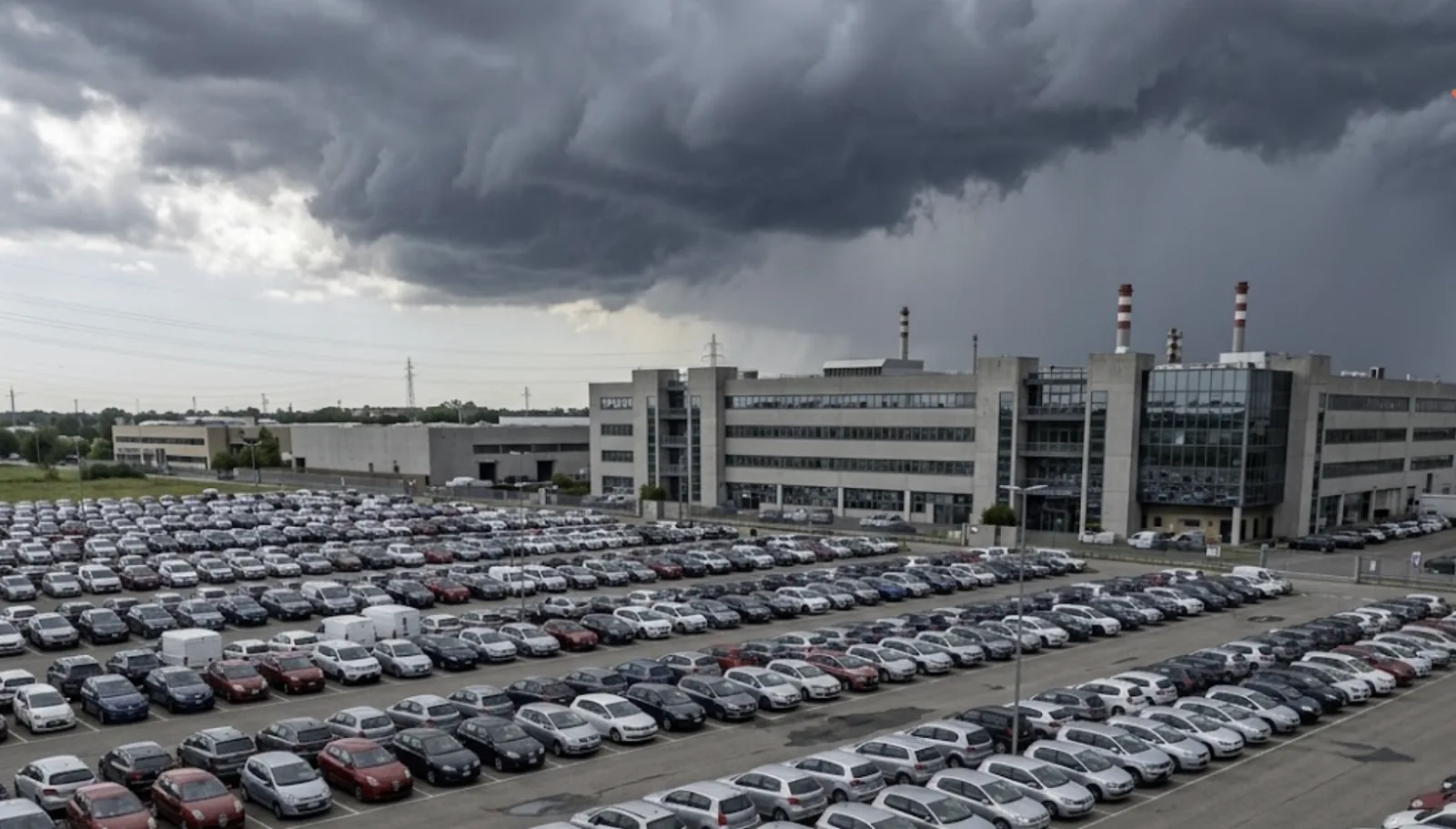
Until a few years ago, investing in the protection of corporate parking lots was considered a secondary infrastructure spend. Today, with the 2026 summer season ahead, for many companies it has become a central topic of Business Continuity, operational resilience and strategic risk management.
The year 2025 was the turning point. On the one hand, extreme weather events reached record peaks in frequency and economic impact; on the other, the introduction of the mandatory Cat Nat insurance (Law 213/2023), in force since 1 January 2025, has definitively accelerated management's attention towards physical prevention.
For companies that manage fleets, logistics yards, car dealerships or vehicle stock, the issue is no longer just the material damage to be repaired after the fact: it is the ability to safeguard assets in order to continue operating without interruption during the most critical months of the year.
Climate risk has become an industrial topic
The destructive hailstorms that have hit Northern Italy in recent years have exposed a concrete vulnerability for the automotive, logistics and transport sectors. These are no longer exceptional events, but a stable economic variable.
ANIA data show that the insurance branch covering land vehicle bodies recorded premium growth of +15.3% in 2024, driven by the surge in claims linked to severe storms and hailstorms.
Insurance companies are now tightening coverage conditions:
- Increasingly penalising deductibles and excesses.
- Stricter caps specifically on hail guarantees.
- Tariff restrictions in high-exposure areas (the Po Valley).
According to the European Severe Weather Database (ESWD), Northern Italy is consistently among the European areas most affected by severe hailstorms. Climate risk is no longer only a meteorological topic: it has become a priority industrial and financial factor for company balance sheets.
How much do you risk by leaving your yard exposed?
Request a free preliminary assessment of the hail risk for your corporate parking lot.
The balance after the Cat Nat obligation: what has changed
More than a year after the entry into force of the Cat Nat insurance obligation (1 January 2025), many companies have had to radically reassess the economic exposure linked to environmental damage and the vulnerability of their operational structures.
The scenario has profoundly changed the way corporate decision-makers assess the financial exposure of fleets and the structural vulnerability of open-air yards. The strategic question is no longer: "How much does it cost to repair the damage?" It is: "How much does it cost to stop?"
For a logistics operator, a June hailstorm can interrupt the distribution chain at peak delivery time. For a car dealership, it can compromise in minutes the commercial value of dozens of vehicles ready for delivery. For an industrial company, it means delays, penalties and rescheduling.
For the full regulatory picture and 2024 damage data, read also the analysis of 2024 hail damages in Northern Italy.
Operational damage often exceeds material damage
When a hailstorm hits a corporate parking lot or a logistics yard, bodywork repair often accounts for only a fraction of the problem. Operational consequences drag on for weeks:
- Company vehicles out of service and long stays in body shops (often saturated in the summer months).
- Cascading slowdowns in logistics and transport planning.
- Economic penalties for delivery delays to customers.
- Extraordinary costs for renting replacement vehicles.
- Saturation of internal administrative workload for claim handling.
- Inevitable increase in insurance premiums in subsequent years.
In the automotive sector, hail damage has a direct impact on the instant depreciation of the inventory and on the saleability of vehicles. The full analysis of the domino effect on exposed sectors is available in the dedicated article on fleet downtime and the hidden costs of hail.
Hail protection covers become a strategic choice
In the current context, covers for corporate parking lots are no longer considered mere accessory shelters. For companies they represent a concrete tool for fleet protection, reduction of economic exposure, operational continuity and fixed-cost containment.
Hail protection structures are particularly strategic for:
- Logistics hubs and goods distribution centres.
- Car dealerships, storage lots and rental companies.
- Public/private transport companies and corporate fleets.
- Industrial yards and parking dedicated to employees and managers.
- Parking and handling areas for high-value assets.
Why corporate decision-makers are changing their approach
The topic of corporate parking protection has moved out of the technical departments and into the strategic tables of:
| Role | Decision driver |
|---|---|
| Fleet Manager | Protection and residual value of the vehicle park. |
| Operations Managers & Logistics Directors | Delivery continuity and punctuality. |
| CFO | Stability of cash flows and containment of insurance costs. |
| Property & Facility Manager | Infrastructural resilience of corporate assets. |
The installation of a structural cover represents a plannable Capex, amortisable over time, capable of eliminating uncertainty linked to unforeseen climate damage, insurance deductible outlays and costly operational blocks. The annual risk calculation for your fleet shows the order of magnitude of the investment avoided.
Euromet: structural protection for fleets and large yards
Euromet designs, engineers and builds modular covers and high-resistance hail protection structures tailored to corporate fleets, car dealerships, logistics yards and large industry. Each solution is configured to measure according to the site's real logistics needs, ensuring modularity, scalability and long-term durability.
All available systems — from Hail Net tensile structures for large surfaces to PVC covers for dealerships and parking — are described on the pillar page dedicated to hail protection covers for cars and fleets.
Frequently asked questions (FAQ)
Request a preliminary risk assessment
The current question is no longer whether to protect corporate parking lots, but how much it risks costing the company to keep leaving them exposed to the next summer hailstorms. Euromet supports companies, fleet managers and logistics operators in designing modular protection structures sized to the site's actual operational criticalities.
Vulnerability analysis of your parking
Contact the Euromet technical office for a preliminary analysis and a proposal sized to your site.